Nanny & Helper
Breastmilk Training
To secure your return to work, our bilingual Nanny Breastmilk Feeding Training equips helpers with essential skills: (1) Safe storage and warming below 40°C to protect antibodies, and (2) Paced bottle-feeding over 15 to 20 minutes to prevent reflux and nipple confusion. This self-paced online course features step-by-step video tutorials and a bilingual competency quiz.
Biên soạn bởi: Nguyễn Thanh Mai — Tư vấn sữa mẹ · Học viên IBCLC · Cập nhật: 12/11/2026.
Protect your breastfeeding journey when returning to work. Designed for both expat and busy Vietnamese families, this bilingual guide solves the quiet worries of leaving your baby with a helper: preventing overheating in boiling water or microwaves (which creates burn hot spots and degrades heat-sensitive immune factors), respecting daily wake-sleep rhythms, and practicing paced bottle-feeding to prevent breast refusal. Parents can also track infant intake using our WHO Growth & Weight Guide.
 Minh họa bởi Nguyễn Thanh Mai — Tư vấn sữa mẹ · Học viên IBCLC
Nanny Integration Kit
- 📋 Bilingual Refrigerator Poster: Safe handling steps.
- 🧪 Bilingual Log Sheet: Daily tracking template.
- 📜 Competency Certificate: Issued on passing the quiz.
Is Your Breastmilk Being Handled Correctly?
Many local nannies are accustomed to formula feeding or traditional high-flow bottle methods. This course bridges the communication gap by explaining the medical reasoning behind your rules in their language:
Incorrect Warming (Overheating Milk)
Helpers accustomed to formula often use boiling water or microwaves to rush heating. Overheating (especially above 55-60°C or microwaving) degrades heat-sensitive antibodies (sIgA, lactoferrin), inactivates living immune cells, and creates burn hot spots. We train nannies to warm gently at 37-40°C.
Rapid Feeding Causing Reflux & Gas
If the nanny tips the bottle vertically, gravity pours milk too fast before the baby can pause to breathe. We train helpers in upright Paced Bottle Feeding so the infant controls the flow rate.
Vigorous Shaking Instead of Swirling
Shaking the bottle hard introduces excess air bubbles that cause gas discomfort and spit-up. Our bilingual lessons show nannies how to gently swirl the bottle to reincorporate the rich fat layer.
| Feeding Metric | Traditional Feeding | Paced Bottle Feeding (Recommended) |
|---|---|---|
| Bottle Angle | Tilted vertically (45°-90°) | Kept horizontal, parallel to the floor |
| Milk Flow Control | Driven by gravity (fast, continuous flow) | Driven by active sucking (slow, baby-controlled) |
| Typical Duration | 5-10 minutes | 15-20 minutes (mimicking breast rhythm) |
| Overfeeding Risk | High (leads to stomach stretching, reflux, colic) | Minimal (baby pauses to recognize fullness cues) |
| Nipple Confusion Risk | High (baby may refuse breast due to fast flow) | Low (protects direct breastfeeding relationship) |
Nanny Breastmilk Feeding Training Workflow
Click on each phase below to see how your nanny is trained to manage your milk and bottle feeding during the day:
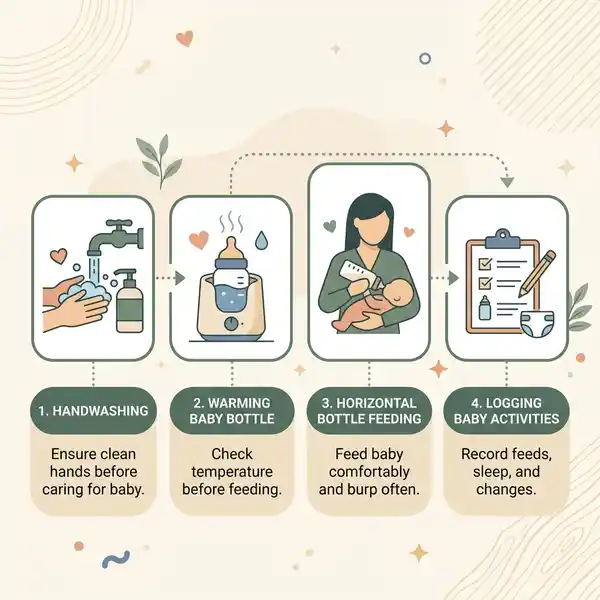 Minh họa bởi Nguyễn Thanh Mai — Tư vấn sữa mẹ · Học viên IBCLC
Explore the Bilingual Modules
Click on the modules and select the lessons to preview the speaking scripts (real conversation tools) and exercises designed for your nanny:
Hygiene & Storage Rules (Vệ sinh & Hạn bảo quản)
Bilingual standards based on CDC Milk Hygiene & Pump Care (PMID 36862586) and our comprehensive guide to safe breastmilk storage and thawing.
Nutrient-Preserving Warming (Hâm sữa bảo toàn)
Gentle warming at 37-40°C and proper swirling rules. Overheating breastmilk (especially above 55-60°C, boiling water, or microwaves) creates burn hot spots, inactivates living immune cells, and significantly degrades heat-sensitive antibodies such as sIgA and lactoferrin (ABM Clinical Protocol #8, PMID 29624432).
Traditional vs Paced Feeding (Bú thường vs Bú chậm)
Resolving reflux, gas, and breast refusal by training the nanny in paced bottle feeding techniques (Kassing 2002, PMID 11845739; bottle-to-breast transition guide).
Step-by-Step Pacing (Từng bước cho bé bú chậm)
Handling bottle alignment and rest intervals. Ensure your nanny checks if the baby is getting enough milk using our wet-diaper indicator tracking.
Nanny Assessment Quiz (Đánh giá Bảo mẫu)
Interactive test to secure their training certificate.
Hygiene & Storage Rules (Vệ sinh & Hạn bảo quản)
🎙️ Course Content / Lời thoại bài giảng:
💬 Practical Communication / Kịch bản đối thoại:
🛠️ Action Step / Nhiệm vụ thực hành:
Equip Your Nanny Today
Get instant access to the training modules and download the bilingual refrigerator poster and daily activity logs:
- ✔️ Bilingual (EN/VI) Refrigerator Milk Safety Poster (PDF): easily printed using our Milk Storage & Pumping Schedule Guide.
- ✔️ Bilingual Daily Baby Tracking Log Template (PDF).
- ✔️ Access to training video modules and competency quiz.
⚠️ Red Flags: When to Seek Immediate Medical Care (Dấu hiệu đỏ cần khám ngay)
Infant Red Flags (Same-Day Pediatric Evaluation / Khám Bác sĩ Nhi khoa ngay trong ngày, không chờ 24-48 giờ): Instruct your nanny to notify parents immediately if the baby shows: (1) Fewer than 6 heavy wet diapers in 24 hours (from day 5 of life), dark yellow urine, or dry lips/mouth; (2) Forceful projectile vomiting, bilious (green) spit-up, or blood in stool; (3) Fever at or above 38.0°C (100.4°F) or unusual lethargy; or (4) Silent choking or turning blue/pale around the lips during bottle feeding (perform infant 5 back blows + 5 chest thrusts and call emergency 115 immediately).
Maternal Red Flags for Working Mothers (Cấp cứu Sản khoa hoặc gọi 115): If the pumping mother develops high fever at or above 38.5°C with chills, rapidly spreading breast redness, purulent discharge, or a fluctuant painful lump suggesting abscess, go to an OB-GYN hospital immediately or call 115 (routine milk engorgement without fever that does not improve after 24-48 hours of conservative care requires medical evaluation).
Clinical References: ABM Clinical Protocol #8: Human Milk Storage (PMID 29624432) · Kassing D. Paced Bottle-Feeding (PMID 11845739) · Zimmerman & Thompson Infant Bottle Feeding Review (PMID 26181720) · AAP HealthyChildren Bottle-Feeding Guide · WHO Infant Feeding Guidelines
Need Instant Lactation or Nanny Setup Support?
If you have urgent questions about how your nanny is feeding your baby at night, or if you need to establish a safe transition plan back to work, reach out directly to Ms. Mai:
Tiếp tục hành trình sữa mẹ của bạn
Dựa trên trang bạn vừa xem, đây là những công cụ liên quan trực tiếp nhất bạn nên khám phá tiếp.
Nanny Training FAQ
Nội dung khóa học song ngữ trên mesuahanhphuc.com mang tính chất giáo dục và tham khảo dựa trên y học thực chứng (ABM, WHO, AAP, CDC), hoàn toàn không thay thế cho việc thăm khám, chẩn đoán hoặc điều trị y khoa trực tiếp từ bác sĩ Chuyên khoa Sản - Nhi. Nguyễn Thanh Mai — Tư vấn sữa mẹ · Học viên IBCLC hỗ trợ hướng dẫn thực hành nuôi con bằng sữa mẹ và kỹ thuật chăm sóc sữa vắt phi lâm sàng, không thực hiện thủ thuật ngoại khoa hay kê đơn thuốc (tuân thủ Luật Khám bệnh, chữa bệnh số 15/2023/QH15). Khi bé có dấu hiệu đỏ (dưới 6 tã ướt nặng trong 24 giờ từ ngày thứ 5 sau sinh, nôn vọt dịch xanh mật, phân lẫn máu, lừ đừ khó đánh thức, sốt từ 38.0°C trở lên), cần đưa bé khám bác sĩ Nhi khoa ngay trong ngày, không chờ 24-48 giờ; nếu bé sặc tím tái ngưng thở cần sơ cứu đường thở và gọi ngay 115. Khi mẹ có dấu hiệu cấp cứu (sốt cao từ 38.5°C kèm ớn lạnh rét run, vệt đỏ nóng lan nhanh, khối sưng bập bùng nghi áp-xe), cần đến bệnh viện Sản - Phụ khoa ngay hoặc gọi 115; tình trạng căng ứ sữa thông thường không giảm sau 24-48 giờ cần được bác sĩ chuyên khoa đánh giá trực tiếp.